 SkyCruncher
Results · Corpus snapshot
Corpus snapshot, 12 July 2026: the old engine's baseline
How the old engine did on a fixed set of 96 frames: how many it could place on the sky, how long that took, and how well its lens model fit at the edges.
Old engine (1.3, July 2026 software), 96 frames, measured 2026-07-12/13.
This page is frozen. It is not updated, and later software would give different numbers.
What this page is
These panels stood on the skycruncher.io Front door from July to October 2026. They were measured with the old engine (the 1.3 software), before the solver was rebuilt. They moved here when the Front door was rebuilt, with the corrections listed at the end of this page.
The whole-corpus sweep that produced them was retired on 2026-09-15. The next Corpus snapshot will come from the new pipeline; there is no date for it yet, and it will get its own page beside this one rather than replace it.
Some words used below. Plate solving works out where on the sky a frame points by matching its stars to a star catalog. A blind solve gets no hint; an assisted solve is given a hint of roughly where to look. A receipt is the record the engine writes for each frame: what ran, what it measured, and what it could not. FITS is the astronomy image format a Seestar saves; CR2 is a Canon camera's raw format.
How plate solving works, and why some solves fail: Plate solving: how a frame finds where it points, and why some fail.
Every number about the frames is measured on the old engine; nothing here describes the new pipeline or the SkyCruncher app.
Frames
96frames 43solved blind 11solved with a hint (assisted) 42not solved 74with a receipt
All 96 frames were in the blind set (no hint about where the camera pointed): 81 were attempted and 15 were skipped (14 as part of a correlated set, 1 too large). The 11 assisted solves are frames that had already failed blind. Blind and assisted (hinted) solves are never pooled: an assisted rescue never inflates a blind rate.
Blind solve rate
44.8%of all frames (43 of 96) 53.1%of attempted frames (43 of 81) 15skipped, never attempted
| Format | Solved / frames | Of all frames | Of attempted | Skipped |
|---|---|---|---|---|
| FITS | 41 / 51 | 80.4% | 82.0% | 1 |
| CR2 | 2 / 45 | 4.4% | 6.5% | 14 |
Blind solves by file format. "Attempted" leaves out the skipped frames.
Run time per frame
10.8 smedian 195.9 sp90: hits the 195.9 s timeout ceiling
The p90 (the time 9 frames in 10 finish within) is the solver's timeout: at least one solve attempt in ten ran until the solver gave up.
Where the time went, over the 40 frames whose timing is broken down by stage: solving took 71.1% of the pipeline's time and 59.4% of wall-clock time.
A hint makes a large difference. On the 11 frames solved both ways, the assisted solve was 19.8× faster than the blind attempt (median): 9.9 s against a blind median of 195.9 s, the same timeout ceiling.
Edge residuals
After a frame is solved, the engine checks how far its stars sit from where the lens model puts them, and whether that error grows toward the edges of the frame. Growth past a threshold means the lens model needs refitting.
39frames measured 15flagged for edge growth 25refit candidates 38,815matched stars used 57not measured
Not measured: 42 frames that were not solved and 11 assisted solves had no matched stars to measure, and 4 frames had too few stars.
A frame is flagged when the error grows by at least 3″ per frame radius and the edge excess is at least 2″. The worst edge growth was on a Canon EOS Rebel T6 frame (lens unknown): edge excess 1,929.1″ (30.5 px), growing 3,008.2″ per radius, over 54 stars.
The old engine's reference data
6.49MGaia stars indexed (Gaia DR3, G < 15) 20.9Mquad patterns, all-sky 15scale bands, 0.25° to 45.25° 2,400+automated tests
old engine, as of
A quad pattern is the shape of four nearby stars, which the solver matches between a frame and the catalog. The scale bands cover fields of view from a quarter of a degree to 45 degrees.
What it shows you
Each panel is the old engine's own rendering of a real measurement record: no mockups, no sample data. The captions are as they stood on the Front door.
-
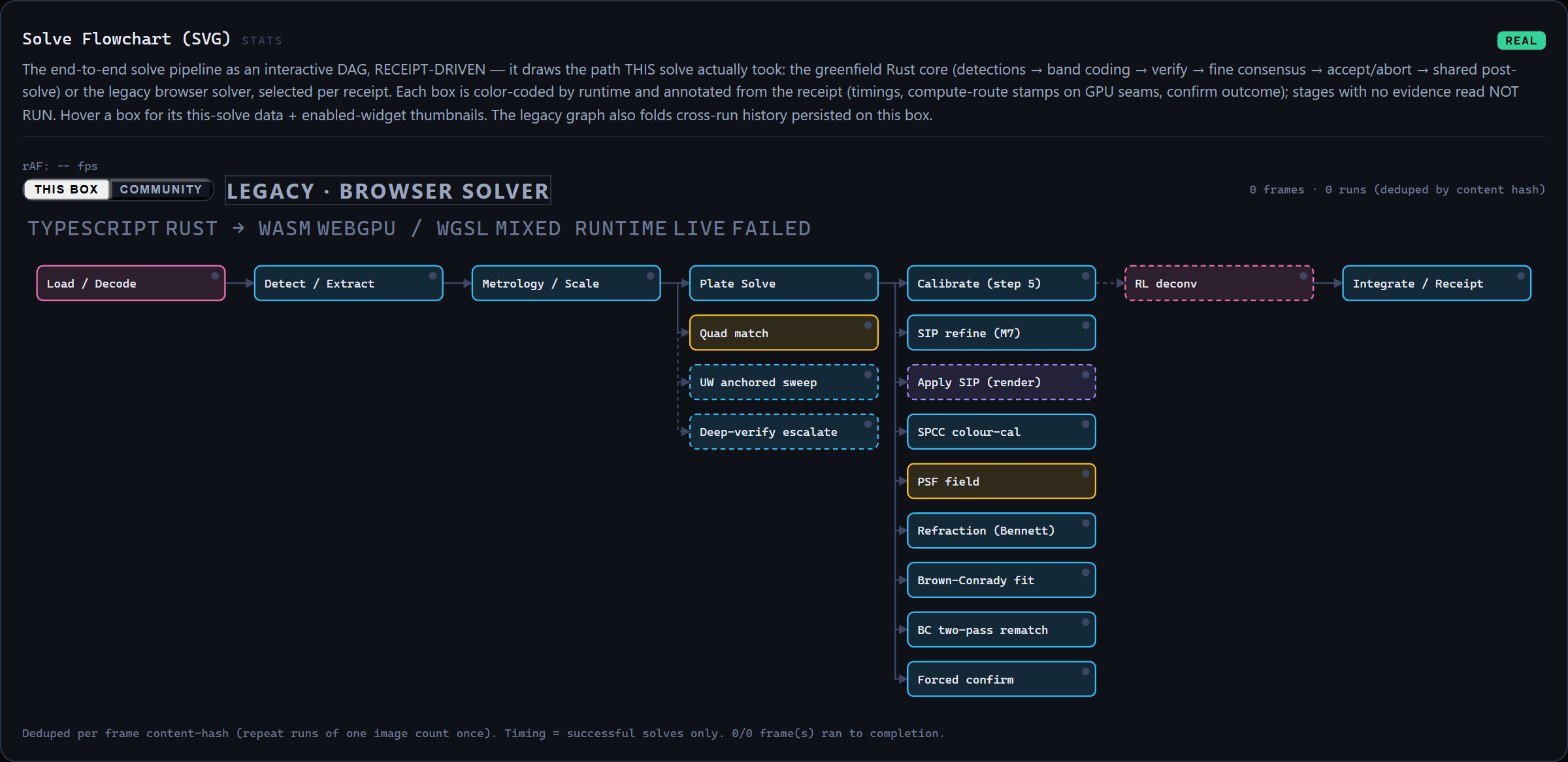
Solve flowchart — the path this solve actually took, drawn from the receipt. Stages with no evidence read NOT RUN. -
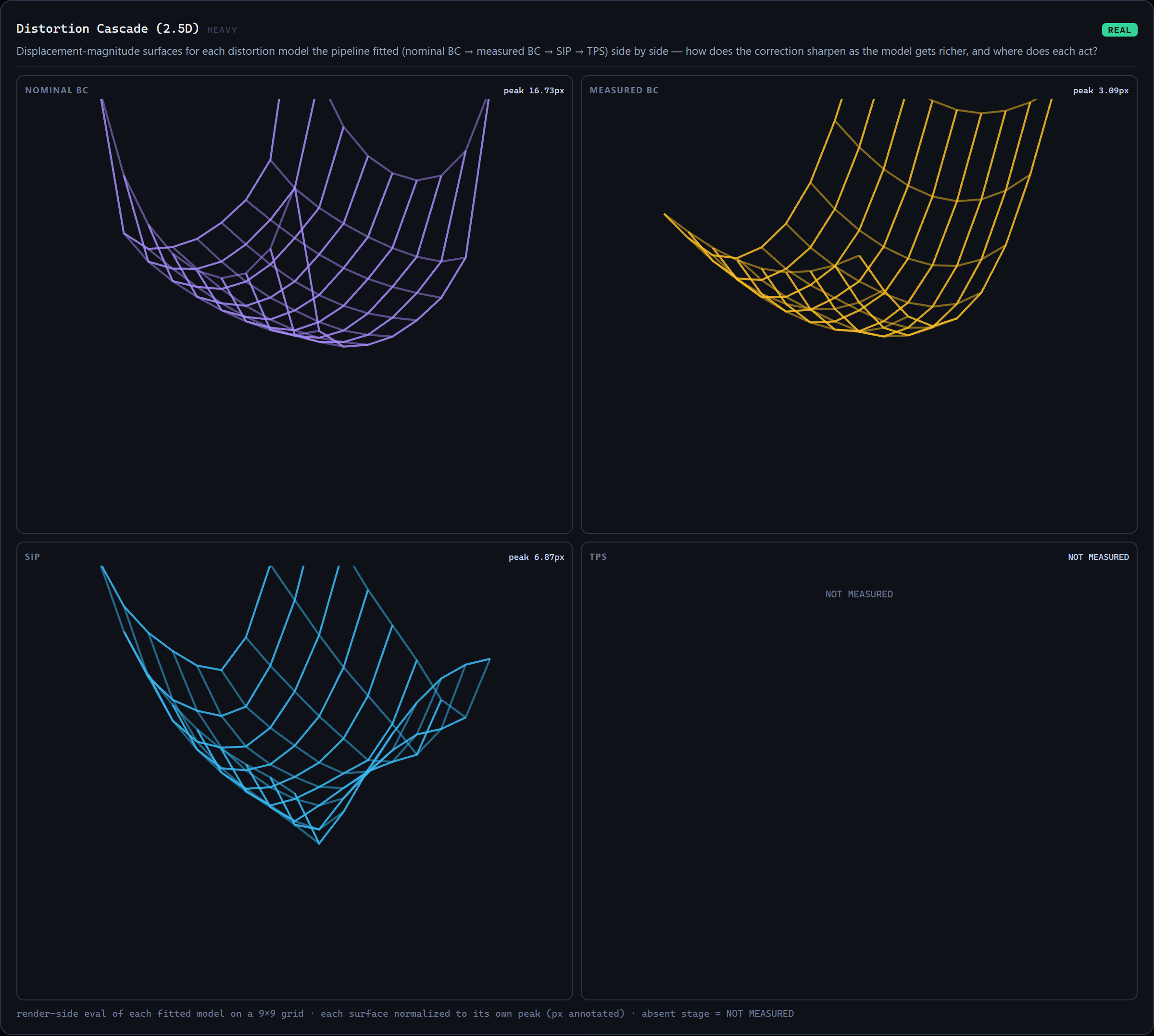
Distortion cascade — displacement surfaces for each model the pipeline fitted. An absent stage says NOT MEASURED, not zero. -
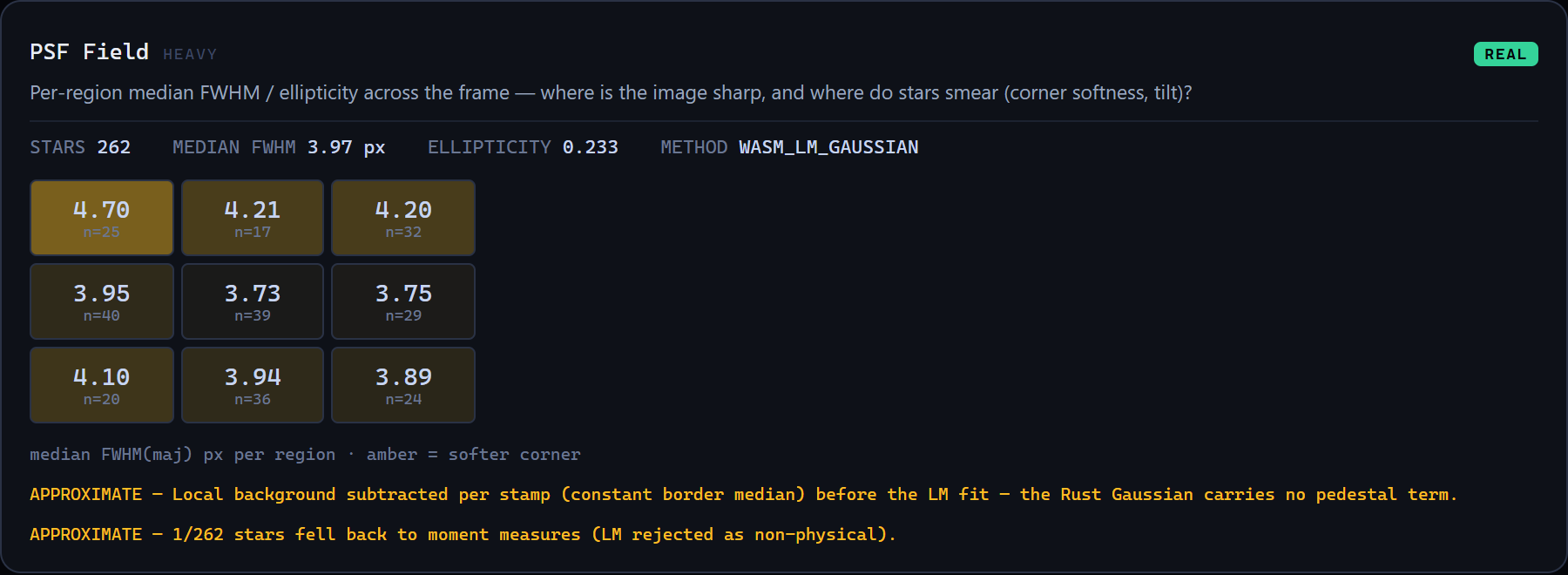
PSF field — per-region star sharpness across the frame, with approximations labeled as such. -
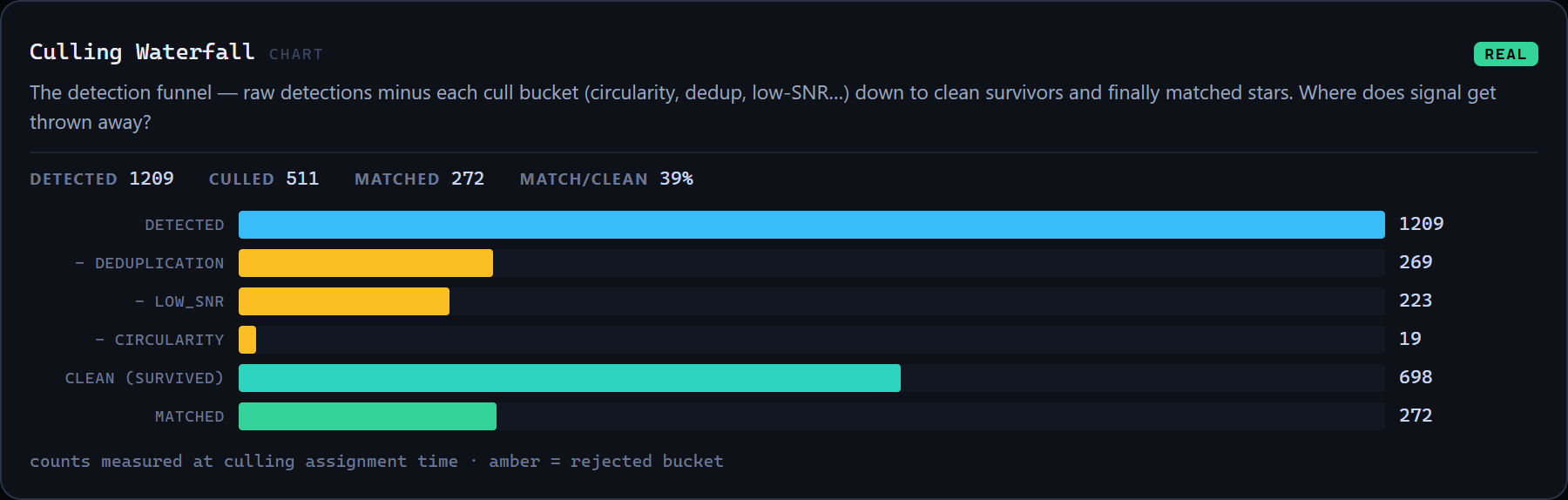
Culling waterfall — where detections get thrown away, counted at the moment of rejection. -
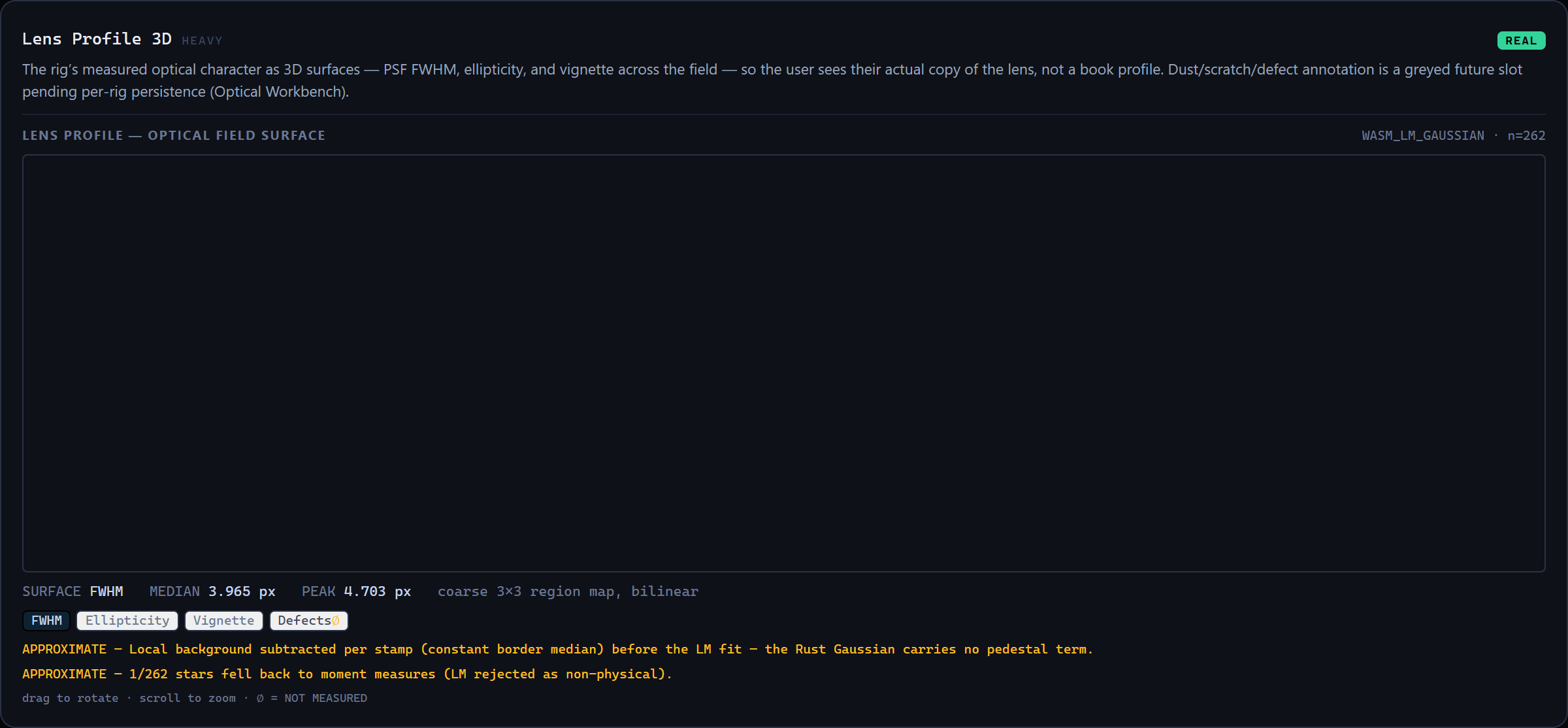
Lens profile — your actual copy of the lens, measured. The 3D surface draws live in-app; this static export carries the measured stats.
Get the data
The numbers on this page come from two files beside it: the corpus summary (JSON), with the frame, solve, residual and timing counts, and the solve-rate series (JSON), which holds this one dated point. The summary also carries a few internal counts this page doesn't show.
Corrections made when moved
Moved
- Fixed the garbled em dash in the note on solve lanes, and in the labels for why frames were not measured (now plain text in the data file).
- Reconciled the attempted-frame count: the old run-time chart said n=82, the solve panel said 81. The data file's own count is 81 attempted frames, and this page uses 81.
- Relabeled the p90 run time: 195.9 s is the solver's timeout ceiling, not a typical slow frame.
- Removed the raw filename of the worst edge-growth frame, from the page and the data file. The camera model is kept.
- Removed "new snapshots land here" and "a fresh regeneration replaces this snapshot": this snapshot is frozen, and a new one gets its own page.
- Removed the live-load hook that could have replaced these numbers from elsewhere. The page now has no script.
- Replaced the two "over time" charts, which each held one point, with that point's values.
- Left out the per-panel source lines and two internal counts the old page never explained. They stay in the data file.
Star data: ESA Gaia DR3 / DPAC.