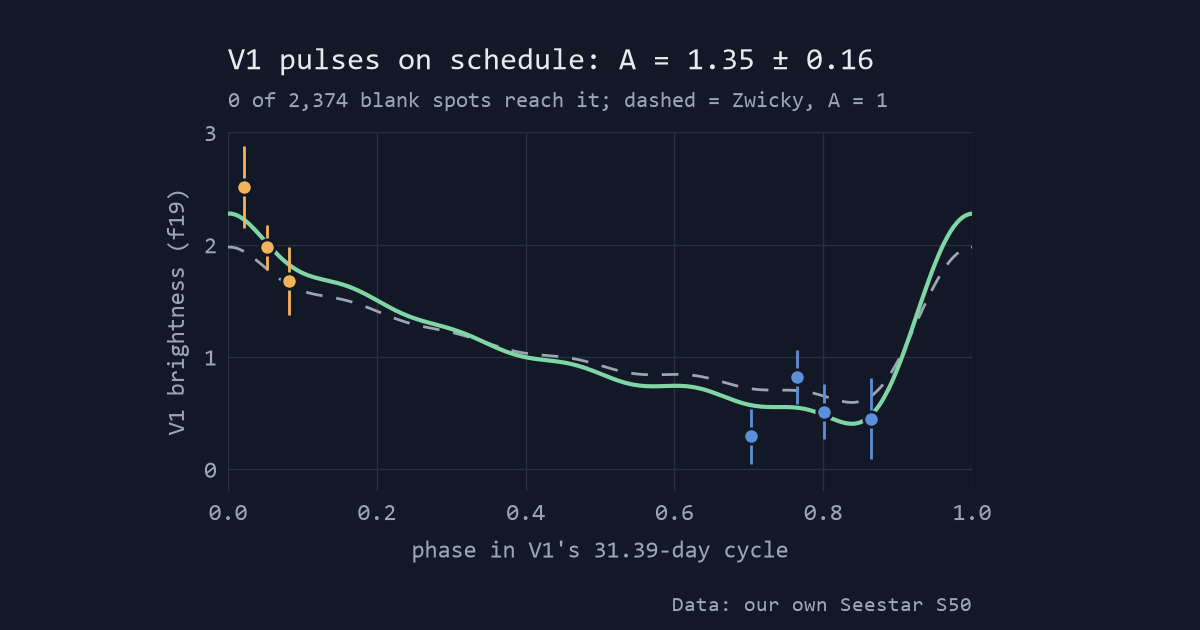
Hubble's V1 pulses on schedule, through a 50 mm lens
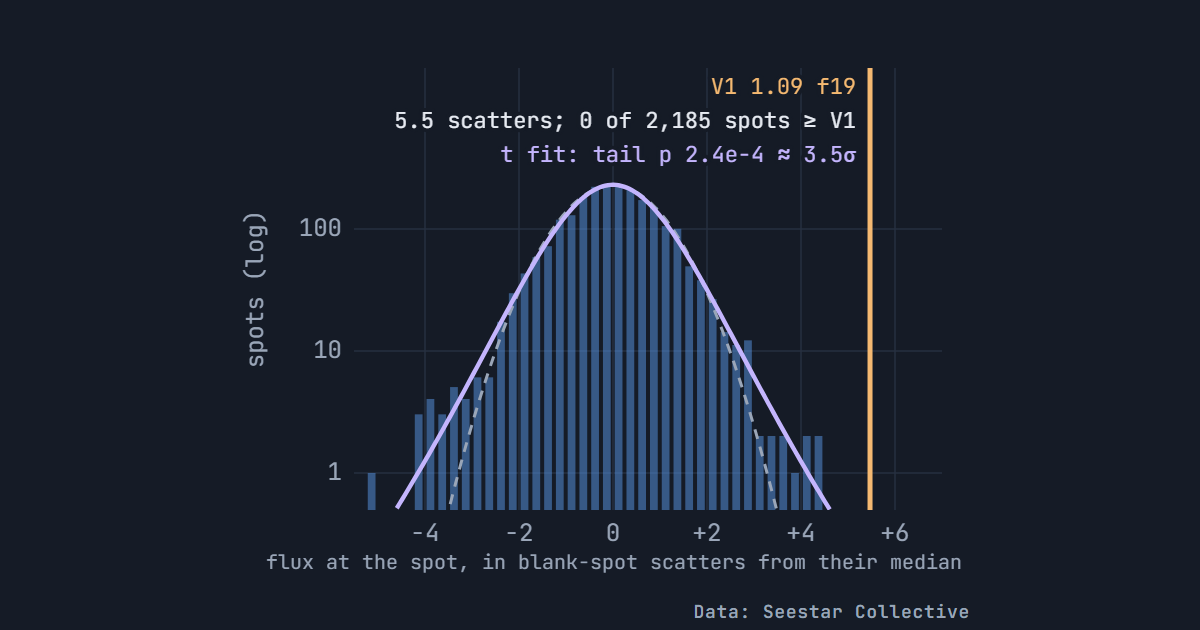
A pre-registered, blind test with a 50 mm Seestar passes: Hubble's V1 pulses on its 31.39-day schedule at 1.35 ± 0.16 of the Zwicky survey's swing, and none of 2,374 empty spots come close.
 Skycruncher
experiments
Each page here is a full write-up of one thing I measured with a small smart telescope: the data, the method, every check I ran, and what went wrong along the way.
A pre-registered, blind test with a 50 mm Seestar passes: Hubble's V1 pulses on its 31.39-day schedule at 1.35 ± 0.16 of the Zwicky survey's swing, and none of 2,374 empty spots come close.
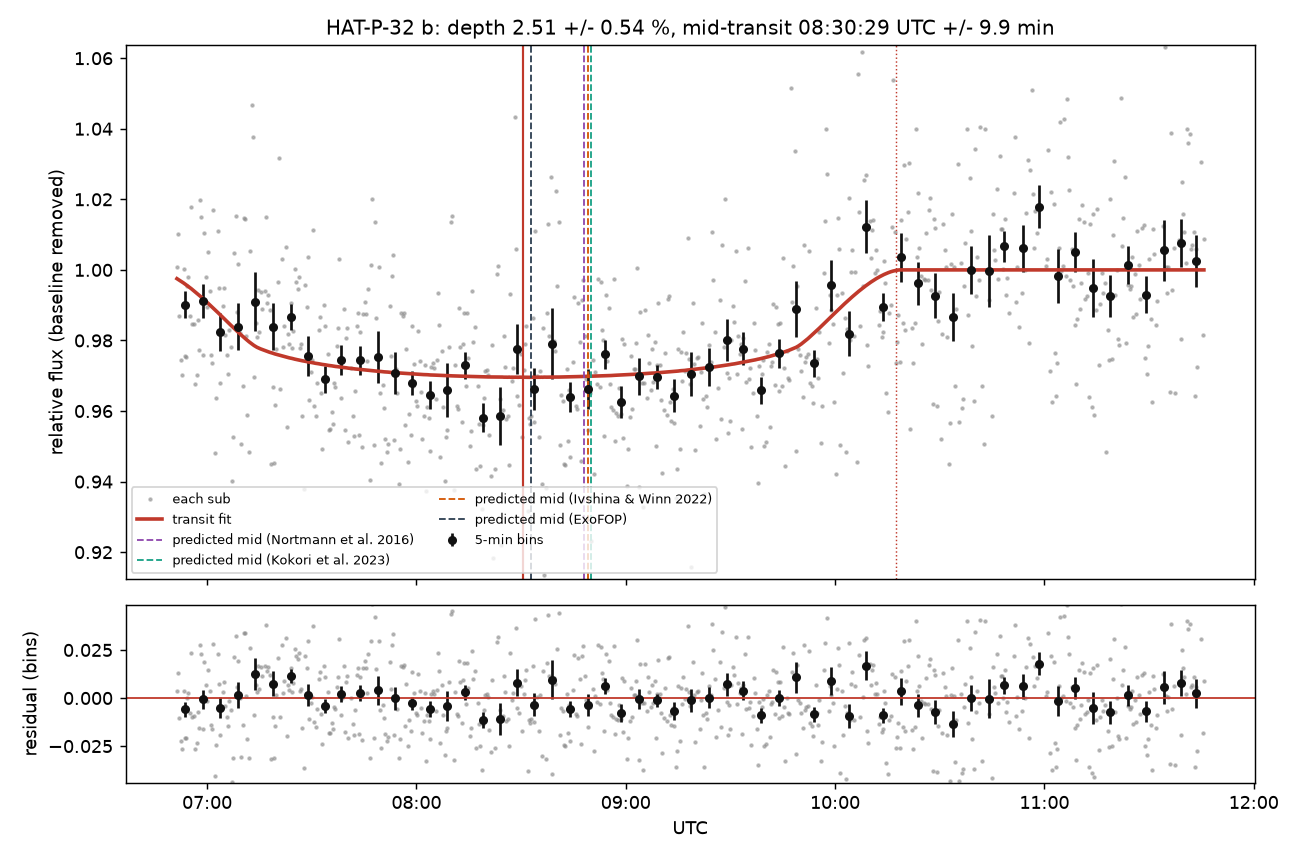
A 50 mm Seestar watched HAT-P-32 b's transit as the subs arrived: depth 1.80 ± 0.24 % at the predicted time, and the live answer matched the whole-night one. The mid-time came out 19.5 minutes early, a baseline problem, so it isn't a timing.
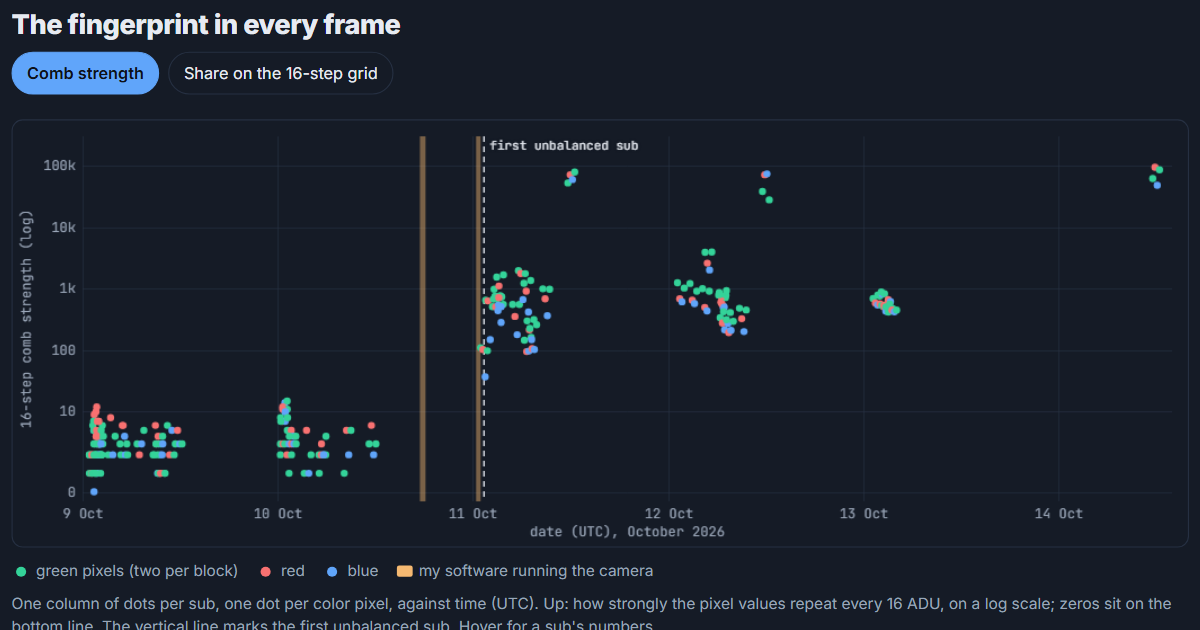
From the night of 10 October my Seestar S50 saved its subs without color gains: green now stops with red and blue near 65,100, and no header card shows it. The pixel values tell you which kind of sub you have.
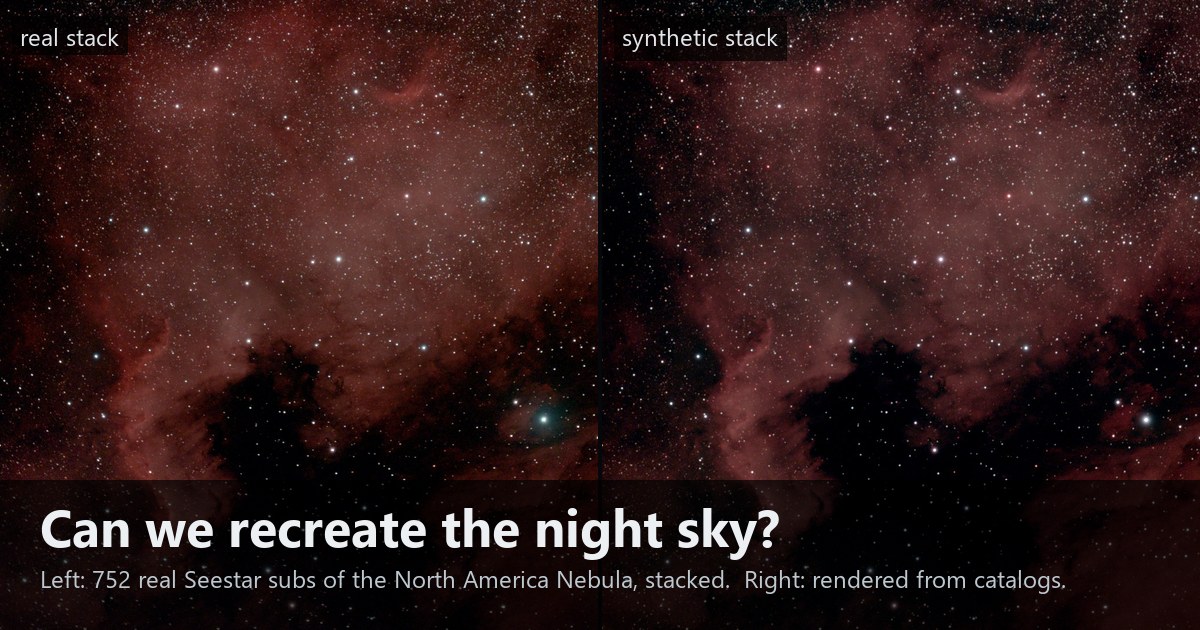
Seestar frames and stacks rendered from star catalogs and sky surveys: our engine solves every synthetic frame and confirms only stars we drew. A real-or-fake quiz, what still gives the fake away, and what it taught us about the engine.
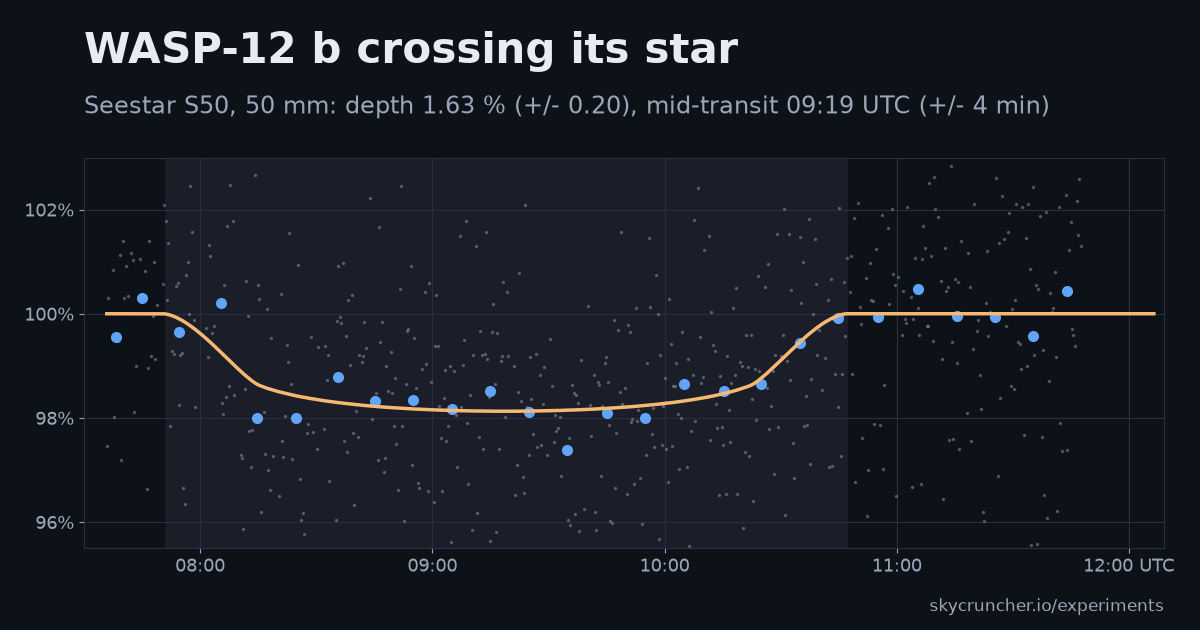
A 50 mm Seestar catches WASP-12 b, the planet whose orbit is shrinking: depth 1.63 ± 0.20 %, on the newest predicted time within half a minute.
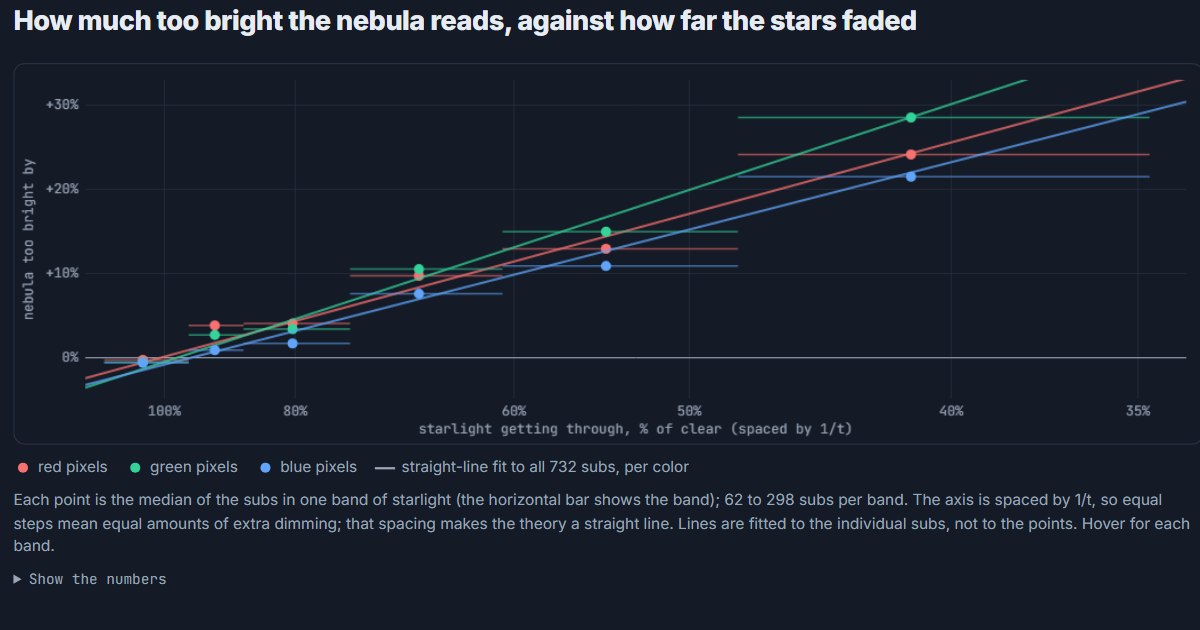
Under thin cirrus, a Seestar's nebula reads too bright for its stars, in proportion to how far they faded (slopes 0.16 to 0.21 over 732 subs), and every star gets a glow whose shape fits diffraction by ice crystals of about 45 micrometers radius.
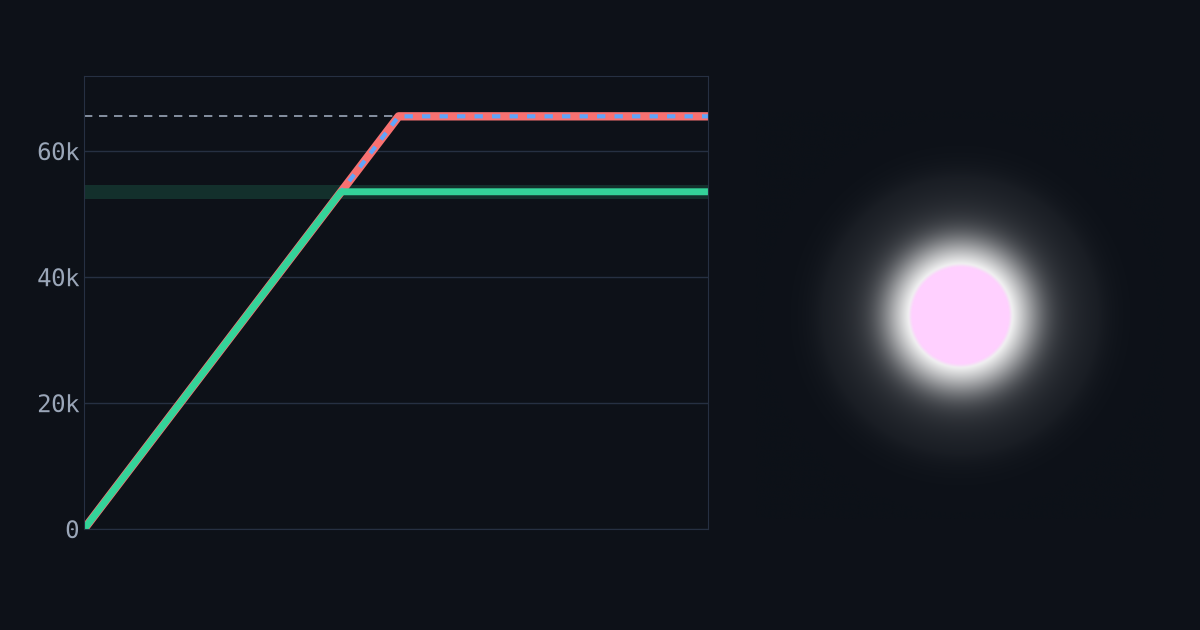
Seestar raw frames stop green at 49,808 to 54,288 while red and blue run to 65,535, so a saturated star core's color comes from the camera and your software, not the star. Measured on 8 units of four models.
Our remote Seestar S50's first two nights: 4,199 of 4,202 subs solved, 0.85 to 0.93 of a community S50's throughput in green, and square star cores that were our own stacker's fault.
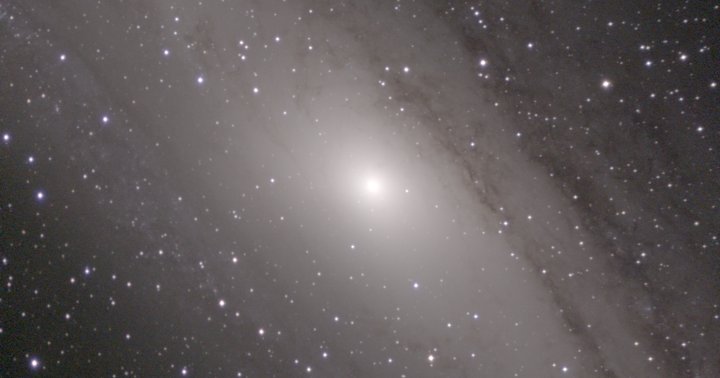
Smart-telescope frames from the Seestar Collective locate Hubble's Cepheid V1 in Andromeda, brighter than every blank disk spot (about 3.5 sigma); its 31.4-day pulse is not confirmed yet.
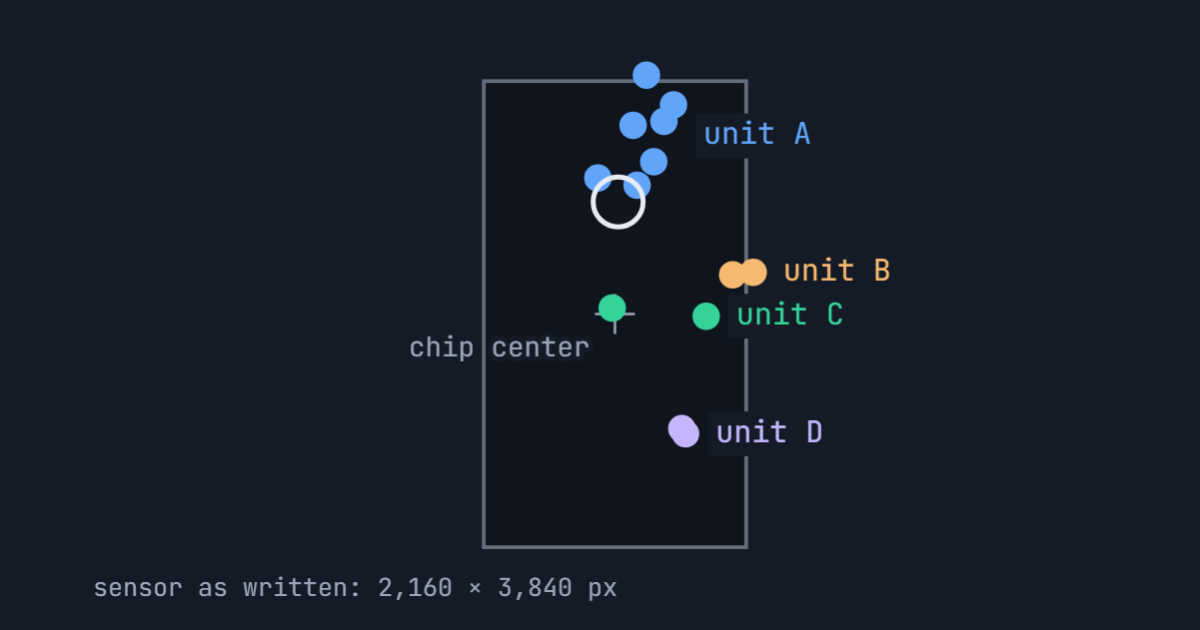
What a Seestar S30 Pro's lens, coma and built-in plate solution do to star positions, measured on four units, and what it means for your stacks.
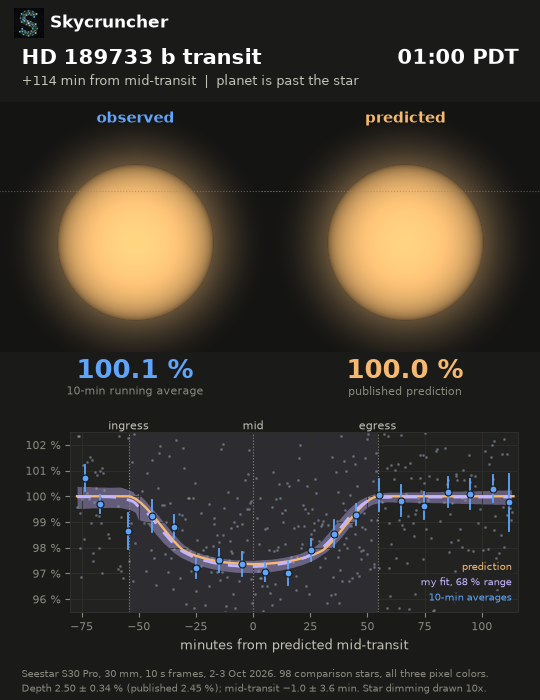
A 30 mm Seestar catches the transit of hot Jupiter HD 189733 b: depth 2.50 ± 0.34 %, on time within minutes.
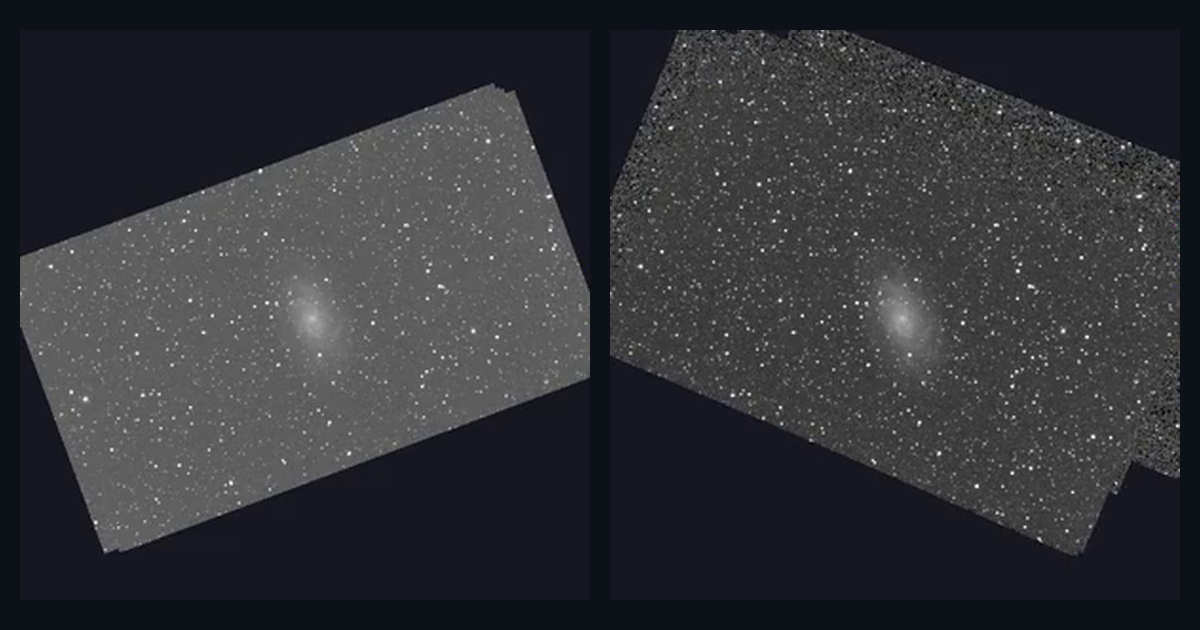
One M 33 night as a flip-book: haze dimmed the stars by about 0.07 mag for 80 minutes and looked like an even veil, not clouds; a faint glow on the galaxy core came with it, cause not settled.
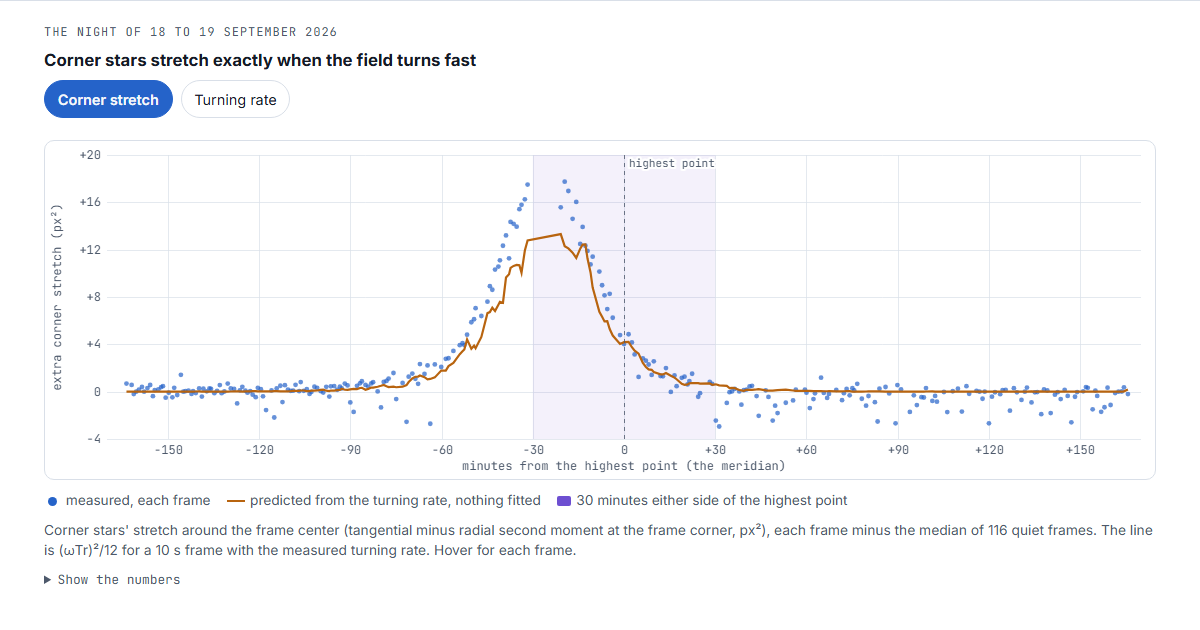
On one alt-azimuth night of M 33, field rotation explains all of the corner-star stretch near the meridian (109 +/- 4 %); the air is under 0.1 %. Whole-frame star size there reads as bad seeing when it isn't.
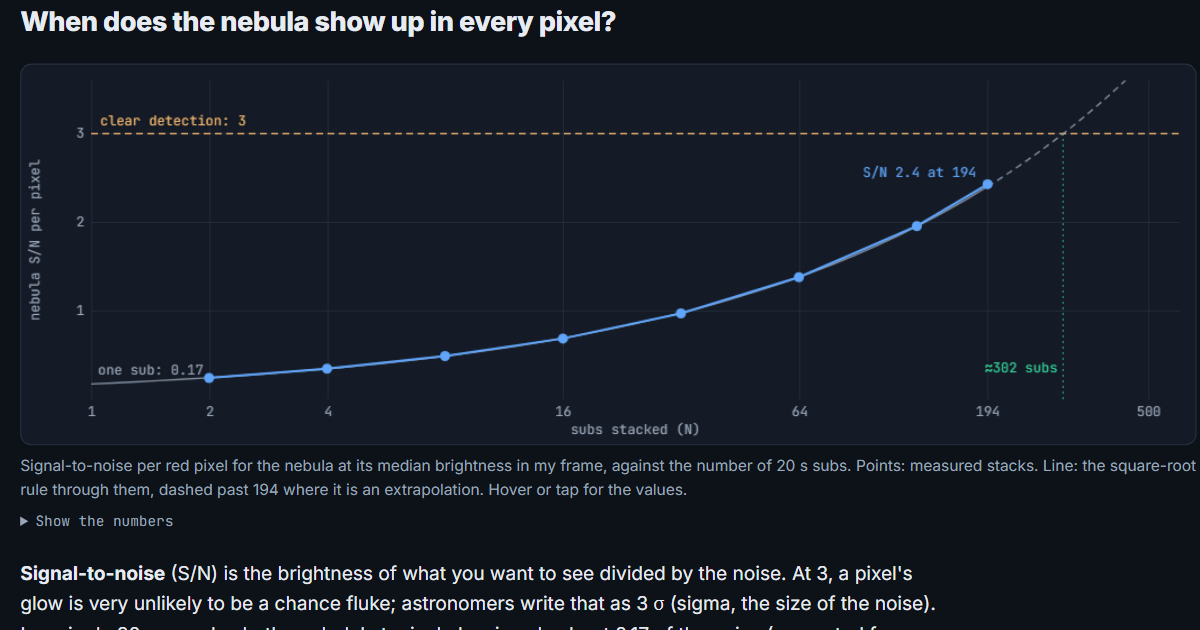
Stacking 194 Seestar subs of NGC 7000: noise falls as the square root of the sub count, and the nebula reaches 2.4 times the noise per pixel, so about 302 subs are needed for a clear 3.
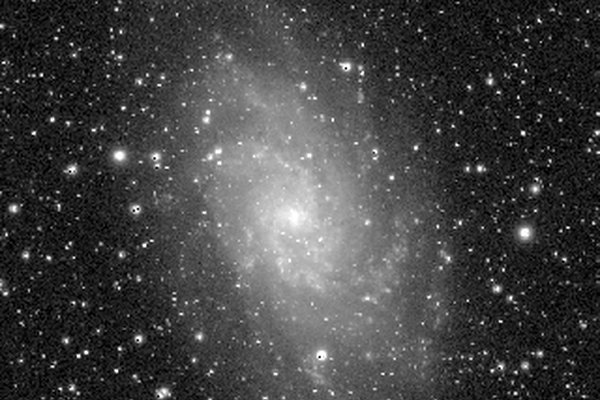
Stacked separately, the even and odd halves of 1,115 Seestar frames show M 33's two-armed pattern pointing the same way in 33 of 34 rings, so the pattern is not noise; a survey check agrees only in some rings.
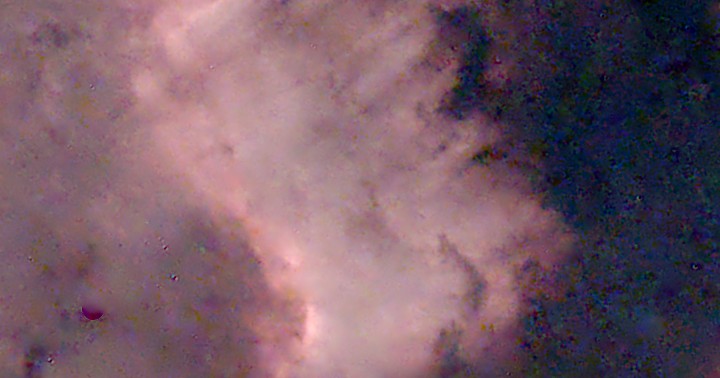
98,258 Gaia stars subtracted from a cloud-corrected Seestar S30 Pro stack of NGC 7000: the nebula left behind tracks the IPHAS H-alpha survey (0.983 over the whole frame).
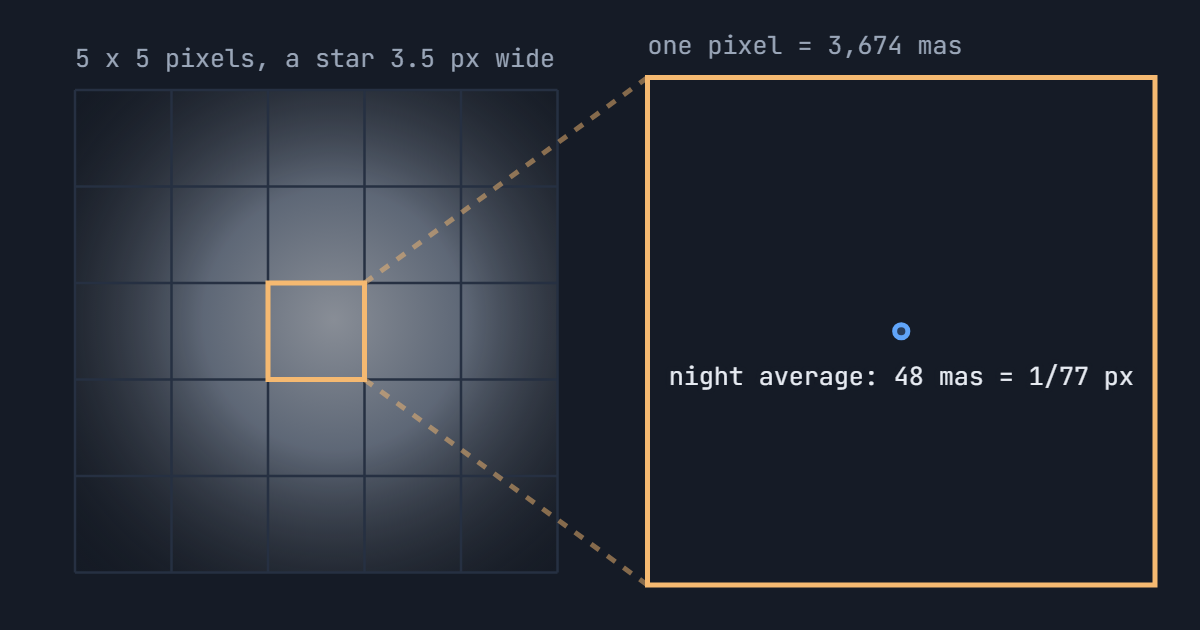
A 30 mm Seestar places G 11-12 stars within 48-66 mas of Gaia over a night; run unchanged on other owners' telescopes, the method met 19 of 22 predictions written in advance.